Buy wnxu.com ?
We are moving the project
wnxu.com .
Are you interested in purchasing the domain
wnxu.com ?
domain@kv-gmbh.de · 0541-91531010
Buy wnxu.com ?
What is kinematic physics?
Kinematic physics is the branch of physics that deals with the motion of objects without considering the forces that cause the motion. It focuses on describing the position, velocity, and acceleration of objects as they move through space and time. Kinematic equations are used to analyze and predict the motion of objects, and they are essential for understanding the behavior of moving bodies in various physical systems. This branch of physics is fundamental for understanding the basic principles of motion and is often a starting point for studying more complex topics in physics. **
How do you establish kinematic constraints?
Kinematic constraints are established by defining the relationships between the motion of different parts of a system. This can be done by specifying the allowable range of motion for each part, as well as any restrictions on their relative positions or velocities. Kinematic constraints can also be implemented through mathematical equations that describe the relationships between the motion variables of the system. By carefully defining these constraints, we can accurately model the behavior of the system and predict its motion under different conditions. **


Similar search terms for Kinematic
Top-Angebote
Products related to Kinematic:
-
William Collins Beautiful News: Positive Trends, Uplifting Stats, Creative Solutions by David McCandlessIn this fascinating follow-up to the bestselling Information is Beautiful and Knowledge is Beautiful, the king of infographics David McCandless uses spectacular visuals to give us all a bit of good news. We are living in the Information Age, in which we are constantly bombarded with data – on television, in print and online. How can we relate to this mind-numbing overload? Enter David McCandless and his amazing infographics: simple, elegant ways to understand information too complex or abstract to grasp any way but visually. In his unique signature style, he creates dazzling displays that blend facts with their connections, contexts and relationships, making information meaningful, entertaining – and beautiful. In his highly anticipated third book, McCandless illustrates positive news from around the world, for an informative, engaging and uplifting collection of new infographic art.5,99 £*Shipping: 2,99 £Secure redirect to the provider


-
How do you set up kinematic constraints?
To set up kinematic constraints, you first need to identify the relationship between the objects or parts that you want to constrain. Then, you can use software tools such as CAD programs or physics engines to define the constraints based on this relationship. Common types of kinematic constraints include revolute joints, prismatic joints, and fixed joints, which restrict the motion of the objects in specific ways. By applying these constraints, you can simulate realistic movements and interactions between the objects in your system. **
-
How do you achieve the kinematic relationship?
The kinematic relationship can be achieved by understanding the motion and position of objects in a system. This involves analyzing the velocity, acceleration, and displacement of the objects over time. By using mathematical equations and principles of physics, such as the equations of motion and Newton's laws, the kinematic relationship can be determined. Additionally, experimental data and observations can be used to validate and refine the kinematic relationship. **
-
How can one reach the kinematic relationship 3?
To reach the kinematic relationship 3, one can use the principles of kinematics to analyze the motion of objects. This involves studying the position, velocity, and acceleration of the objects and using equations and formulas to establish the relationships between these variables. Additionally, one can use graphical methods, such as velocity-time and position-time graphs, to visualize and understand the kinematic relationships. Finally, conducting experiments and collecting data can help to validate and confirm the kinematic relationships. **
-
What is the solution method for kinematic problems in physics?
The solution method for kinematic problems in physics involves using the equations of motion to analyze the motion of an object. These equations include the equations for constant velocity, constant acceleration, and projectile motion. By identifying the known and unknown variables, such as initial velocity, final velocity, acceleration, displacement, and time, we can use the appropriate equation to solve for the unknown variable. It is important to carefully consider the given information and choose the correct equation to use in order to accurately solve kinematic problems in physics. **

Can you help me with a kinematic problem in physics?
Yes, I can help you with a kinematic problem in physics. Kinematics deals with the motion of objects without considering the forces that cause the motion. If you provide me with the specific details of the problem, such as the initial and final positions, velocities, accelerations, and time, I can help you solve for the unknown quantities using the kinematic equations. Feel free to ask me any specific questions you have about the problem, and I'll do my best to assist you. **
Could someone explain or break down the transformation of this kinematic formula for me?
Sure! The kinematic formula that describes the relationship between initial velocity (u), final velocity (v), acceleration (a), and displacement (s) is given by the equation: v^2 = u^2 + 2as. This formula can be derived from the equations of motion by using the equation v = u + at and the equation s = ut + (1/2)at^2. By substituting the expression for t from the first equation into the second equation and then substituting the resulting expression for s into the equation v = u + at, we can arrive at the kinematic formula v^2 = u^2 + 2as. This formula is commonly used to solve problems involving motion under constant acceleration. **
Top-Angebote
Products related to Kinematic:
-
Roku HD Streaming StickTransform any TV into America’s #1 streaming platform with the Roku Streaming Stick HD. Enjoy quick access to 500+ free HD channels, including live news, sports, weather, and more — all from a sleek, compact device that stays out of sight. Key Features TV Streaming Made Easy: Explore popular apps, free movies, shows, and live TV effortlessly. Streaming has never been simpler or more fun. Compact Design, No Compromises: The stick’s slim design won’t block adjacent HDMI ports and even powers directly from your TV — no wall outlet or extra cords needed. All-in-One Remote: Control your TV and Roku device with a single remote. Adjust volume, power on/off, and search using voice commands. Portable Entertainment: Take your favorite shows with you while traveling without needing to log in on other devices. Bluetooth Headphone Mode: Stream privately by pairing your headphones directly to the Roku Streaming Stick. Apps & Entertainment BBC iPlayer All 4 Netflix Amazon Prime Video YouTube Apple TV+ Disney+ Vimeo Movie rentals Interfaces & Connectivity Wi-Fi enabled General Information Remote control included Compatible with HD TVs EAN: 82961000844827,99 £*Shipping: 0,00 £Secure redirect to the provider
-
Ronald Redding Streaming Cheetah Linen WallpaperMarble veining and animal skin combine to compose a stream of color and print in pattern Streaming Cheetah. This Streaming Cheetah Wallpaper measures approximately 27 inches wide by 27 feet long, covering About 60.8 square feet per roll.170,00 $*Shipping: 0,00 $Secure redirect to the provider
-
What is kinematic physics?
Kinematic physics is the branch of physics that deals with the motion of objects without considering the forces that cause the motion. It focuses on describing the position, velocity, and acceleration of objects as they move through space and time. Kinematic equations are used to analyze and predict the motion of objects, and they are essential for understanding the behavior of moving bodies in various physical systems. This branch of physics is fundamental for understanding the basic principles of motion and is often a starting point for studying more complex topics in physics. **
-
How do you establish kinematic constraints?
Kinematic constraints are established by defining the relationships between the motion of different parts of a system. This can be done by specifying the allowable range of motion for each part, as well as any restrictions on their relative positions or velocities. Kinematic constraints can also be implemented through mathematical equations that describe the relationships between the motion variables of the system. By carefully defining these constraints, we can accurately model the behavior of the system and predict its motion under different conditions. **
-
How do you set up kinematic constraints?
To set up kinematic constraints, you first need to identify the relationship between the objects or parts that you want to constrain. Then, you can use software tools such as CAD programs or physics engines to define the constraints based on this relationship. Common types of kinematic constraints include revolute joints, prismatic joints, and fixed joints, which restrict the motion of the objects in specific ways. By applying these constraints, you can simulate realistic movements and interactions between the objects in your system. **
-
How do you achieve the kinematic relationship?
The kinematic relationship can be achieved by understanding the motion and position of objects in a system. This involves analyzing the velocity, acceleration, and displacement of the objects over time. By using mathematical equations and principles of physics, such as the equations of motion and Newton's laws, the kinematic relationship can be determined. Additionally, experimental data and observations can be used to validate and refine the kinematic relationship. **
Similar search terms for Kinematic
-
William Collins Beautiful News: Positive Trends, Uplifting Stats, Creative Solutions by David McCandlessIn this fascinating follow-up to the bestselling Information is Beautiful and Knowledge is Beautiful, the king of infographics David McCandless uses spectacular visuals to give us all a bit of good news. We are living in the Information Age, in which we are constantly bombarded with data – on television, in print and online. How can we relate to this mind-numbing overload? Enter David McCandless and his amazing infographics: simple, elegant ways to understand information too complex or abstract to grasp any way but visually. In his unique signature style, he creates dazzling displays that blend facts with their connections, contexts and relationships, making information meaningful, entertaining – and beautiful. In his highly anticipated third book, McCandless illustrates positive news from around the world, for an informative, engaging and uplifting collection of new infographic art.5,99 £*Shipping: 2,99 £Secure redirect to the provider
-
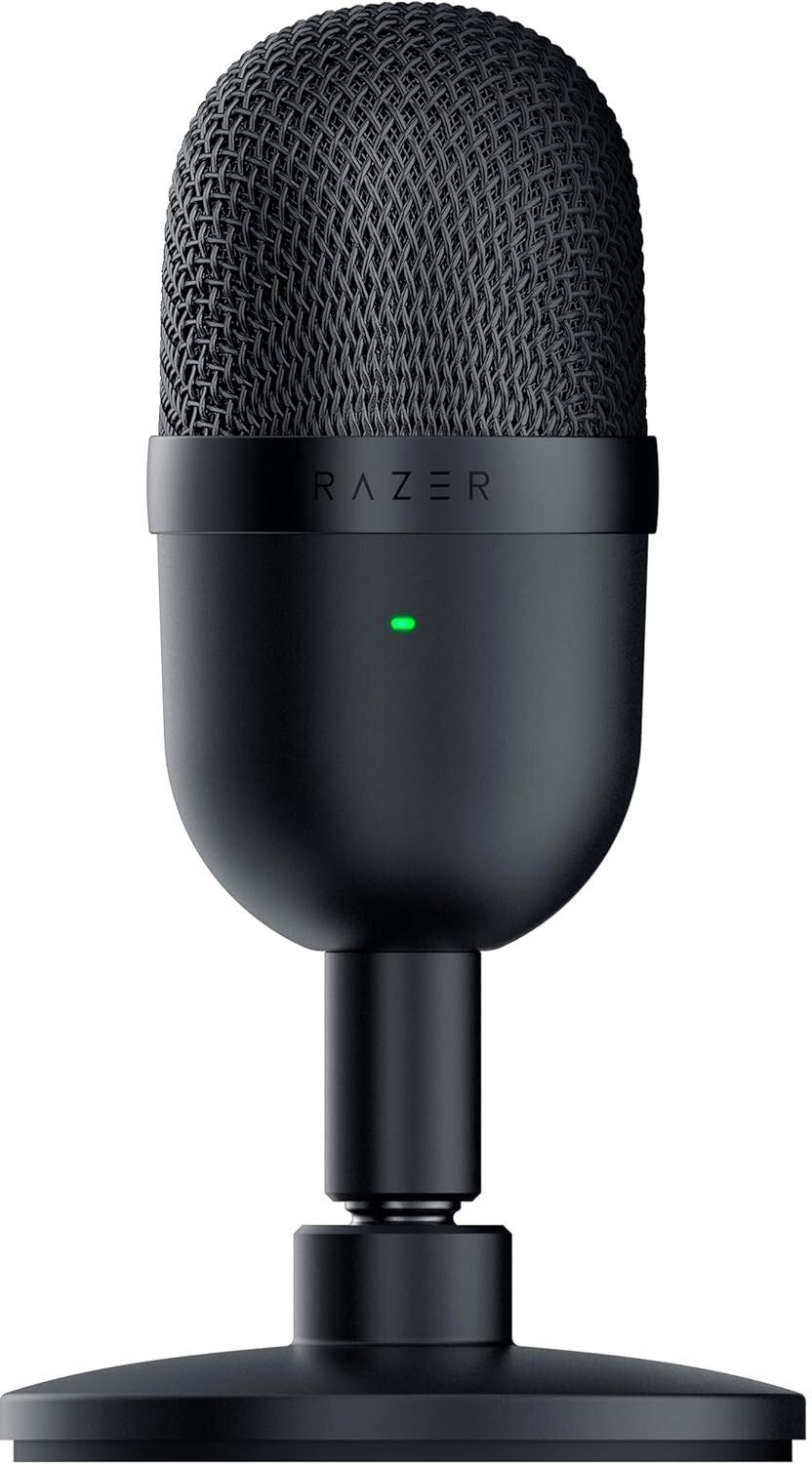
Razer Seiren Mini – USB Condenser Microphone for Streaming, Used - GoodOverview The Razer Seiren Mini is a compact, professional-grade USB condenser microphone designed to deliver crisp, clear audio for streamers, gamers, podcasters and home workers. With its ultra-precise supercardioid pickup pattern and plug-and-play USB connectivity, it offers studio-level voice capture in a small, stylish form factor. Perfect for desktops with limited space, this microphone enhances your recordings and live streams with exceptional clarity and noise reduction. Key Features • Ultra-precise supercardioid pickup pattern for focused voice capture • Professional-grade 14mm condenser capsule for rich, clear audio • Compact, minimalist design ideal for small setups • Built-in shock mount to minimise vibrations and accidental knocks • Plug-and-play USB connectivity for instant setup • Heavy-duty adjustable stand for stable desk placement • Compatible with Windows, macOS and popular streaming platforms • Available in a sleek matte black finish Benefits The Razer Seiren Mini delivers broadcast-quality audio without requiring complex setups or bulky equipment. Its supercardioid pattern reduces background noise, making your voice stand out clearly during live streams, calls or recordings. Compact yet powerful, it fits seamlessly into any workspace and ensures a clean, professional sound experience for gaming, content creation and online meetings. Specifications Table Specification Details Model Razer Seiren Mini Type USB Condenser Microphone Pickup Pattern Supercardioid Capsule Size 14mm Connectivity USB Frequency Response 20Hz – 20kHz Sample Rate 44.1kHz / 48kHz Bit Depth 16-bit Dimensions Approx. 9.0 x 5.0 x 5.0cm (mic body) Weight Approx. 160g (mic only) Compatibility Windows, macOS, streaming platforms Colour Black39,00 £*Shipping: 0,00 £Secure redirect to the provider
-
Uplift Essentials Hot And Cold Radio Frequency Skin Rejuvenation Device Hot And Cold Radio Frequency Skin Rejuvenation DeviceOptimize your daily antiaging routine and achieve a noticeably firmer, fully lifted appearance using the combined power of radio frequency technology and thermodynamic regulation. The Hot and Cold Radio Frequency Skin Rejuvenation Device takes the...340,97 $*Shipping: 0,00 $Secure redirect to the provider
-
How can one reach the kinematic relationship 3?
To reach the kinematic relationship 3, one can use the principles of kinematics to analyze the motion of objects. This involves studying the position, velocity, and acceleration of the objects and using equations and formulas to establish the relationships between these variables. Additionally, one can use graphical methods, such as velocity-time and position-time graphs, to visualize and understand the kinematic relationships. Finally, conducting experiments and collecting data can help to validate and confirm the kinematic relationships. **
-
What is the solution method for kinematic problems in physics?
The solution method for kinematic problems in physics involves using the equations of motion to analyze the motion of an object. These equations include the equations for constant velocity, constant acceleration, and projectile motion. By identifying the known and unknown variables, such as initial velocity, final velocity, acceleration, displacement, and time, we can use the appropriate equation to solve for the unknown variable. It is important to carefully consider the given information and choose the correct equation to use in order to accurately solve kinematic problems in physics. **
-
Can you help me with a kinematic problem in physics?
Yes, I can help you with a kinematic problem in physics. Kinematics deals with the motion of objects without considering the forces that cause the motion. If you provide me with the specific details of the problem, such as the initial and final positions, velocities, accelerations, and time, I can help you solve for the unknown quantities using the kinematic equations. Feel free to ask me any specific questions you have about the problem, and I'll do my best to assist you. **
-
Could someone explain or break down the transformation of this kinematic formula for me?
Sure! The kinematic formula that describes the relationship between initial velocity (u), final velocity (v), acceleration (a), and displacement (s) is given by the equation: v^2 = u^2 + 2as. This formula can be derived from the equations of motion by using the equation v = u + at and the equation s = ut + (1/2)at^2. By substituting the expression for t from the first equation into the second equation and then substituting the resulting expression for s into the equation v = u + at, we can arrive at the kinematic formula v^2 = u^2 + 2as. This formula is commonly used to solve problems involving motion under constant acceleration. **
* All prices are inclusive of VAT and, if applicable, plus shipping costs. The offer information is based on the details provided by the respective shop and is updated through automated processes. Real-time updates do not occur, so deviations can occur in individual cases. ** Note: Parts of this content were created by AI.